


Understanding Gross Sales vs Net Sales: A Foundation for Business Insight
Every business leader knows the importance of sales. However, simply looking at your total revenue can be misleading. To truly understand your company’s financial health, you must differentiate between gross sales vs net sales. This distinction is not just an accounting formality. It forms the bedrock of strategic decision-making. Ignoring it can lead to flawed insights and poor business outcomes. We will explore these crucial concepts in detail.
As an Odoo consulting partner, Odiware Technologies helps businesses like yours navigate these complexities. We ensure your Odoo ERP system provides accurate, actionable financial data. Let’s demystify gross sales vs net sales and see why this knowledge is indispensable for your operations in 2025 and beyond.
What Are Gross Sales?
Gross sales represent the total value of all sales transactions made by a company within a specific reporting period. This figure includes all revenue generated from product sales and services rendered. It does not account for any deductions, returns, or discounts. Think of it as the raw, unfiltered income your business brings in. It’s the starting point before any adjustments.
For example, if you sell 100 units of a product at $50 each, your gross sales would be $5,000. This is true even if some customers later return items or receive discounts. Gross sales provide a snapshot of your company’s sales volume and activity. It shows the sheer scale of your customer engagement. You can learn more about this foundational metric by exploring a detailed explanation of gross sales.
Why Gross Sales Matter
Gross sales are important for several reasons. They indicate the effectiveness of your sales and marketing efforts. A high gross sales figure suggests strong market demand for your offerings. It also shows your sales team’s ability to close deals. This metric is a good indicator of your market penetration. It helps you understand your overall top-line revenue generation.
However, relying solely on gross sales can be misleading. It does not reflect the actual cash your business retains after all adjustments. This is where the concept of net sales becomes crucial. Understanding both gross sales vs net sales gives you a complete picture.
What Are Net Sales?
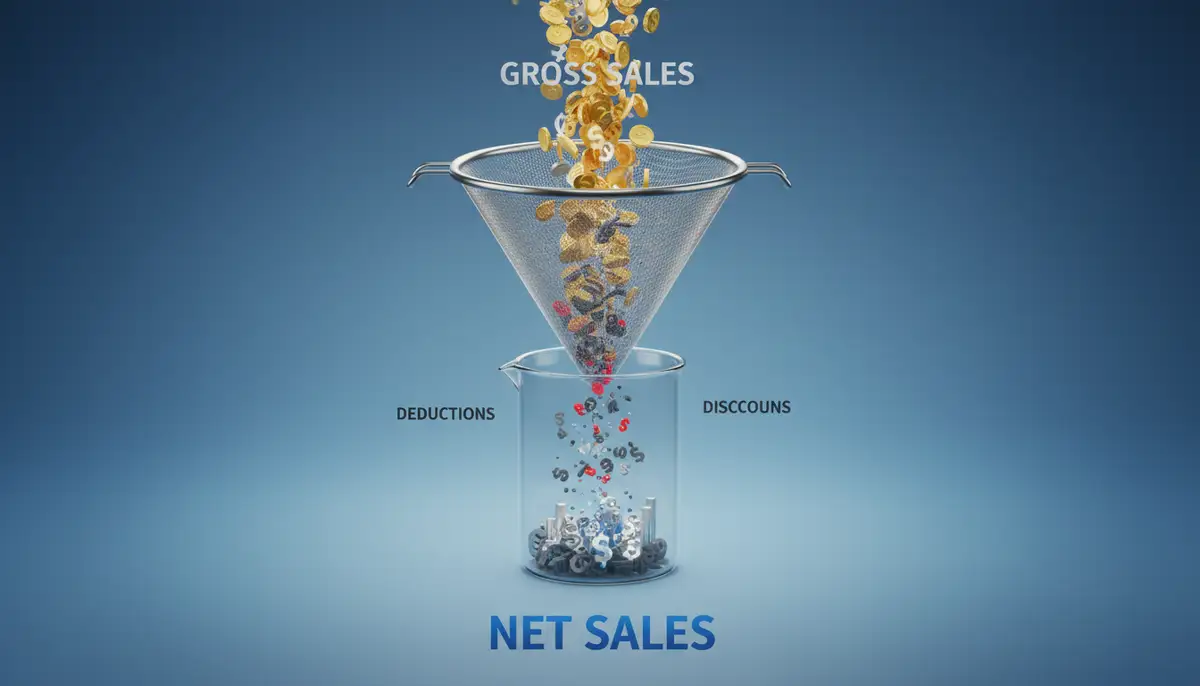
Net sales represent the actual revenue a company earns after accounting for various deductions. These deductions typically include sales returns, sales allowances, and sales discounts. Net sales give a more accurate picture of the revenue available to cover operating expenses and generate profit. It is a much more realistic measure of your company’s financial performance.
To calculate net sales, you subtract these deductions from your gross sales. The formula is straightforward: Net Sales = Gross Sales – (Sales Returns + Sales Allowances + Sales Discounts). This refined figure is what truly impacts your bottom line. It shows what revenue you actually keep. HubSpot’s blog offers a clear breakdown of gross vs net sales and their differences.
Key Deductions Explained
- Sales Returns: These are credits given to customers for merchandise they send back. For instance, a customer buys a product but returns it because it’s faulty or not what they expected.
- Sales Allowances: These are reductions in the selling price of goods or services. This happens when customers keep damaged or defective goods but receive a partial refund or credit instead of a full return. It’s a way to resolve issues without a full return.
- Sales Discounts: These are price reductions offered to customers, often for early payment. For example, a ‘2/10, net 30’ discount means a 2% discount if paid within 10 days, otherwise the full amount is due in 30 days. These incentives boost cash flow.
Why Net Sales Matter More for Profitability
Net sales are a more accurate indicator of your company’s actual revenue. This figure is used to calculate gross profit, operating income, and ultimately, net income. It directly impacts your profitability ratios. Investors and creditors pay close attention to net sales. They use it to assess a company’s financial health and stability. A strong net sales figure suggests efficient operations and customer satisfaction.
Understanding the difference between gross sales vs net sales is crucial for financial reporting. It impacts how your business is valued. It also affects how you make strategic decisions. Zendesk provides further insights into gross sales vs net sales key differences and their implications.
Gross Sales vs Net Sales: The Core Distinction and Business Impact
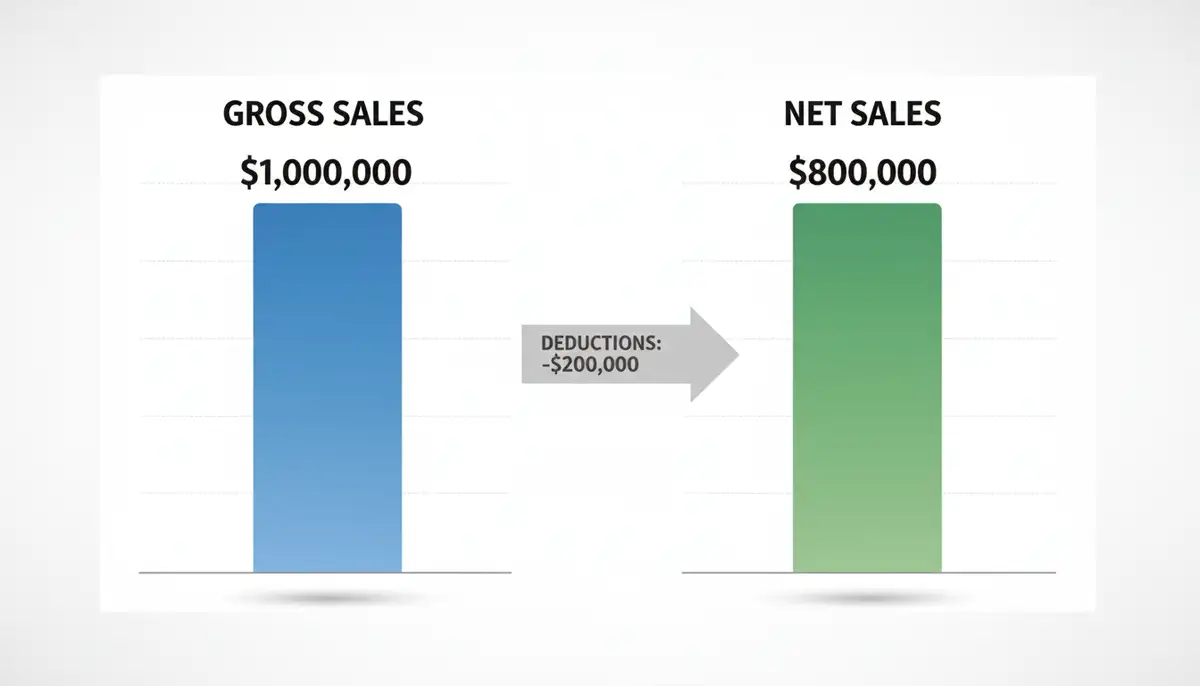
The fundamental difference between gross sales vs net sales lies in the deductions. Gross sales are the total, unadjusted revenue. Net sales are the revenue after accounting for returns, allowances, and discounts. This distinction is not merely academic. It has profound implications for how you manage your business.
Consider this: high gross sales might look impressive on paper. However, if your sales returns are also very high, your net sales could be significantly lower. This indicates issues with product quality, customer expectations, or sales processes. A robust understanding of gross sales vs net sales helps you identify these underlying problems. It guides you toward effective solutions.
| Metric | Definition | Key Characteristic | Business Insight |
|---|---|---|---|
| Gross Sales | Total revenue from all sales transactions before deductions. | Unadjusted, top-line revenue. | Indicates sales volume and market demand. |
| Net Sales | Gross sales minus returns, allowances, and discounts. | Adjusted, actual revenue. | Reflects true profitability and operational efficiency. |
This table highlights why both metrics are important, but net sales offer a more realistic view. For a deeper dive into these concepts, you might find this video helpful:
.
Strategic Decisions Driven by Gross Sales vs Net Sales
Accurate reporting of gross sales vs net sales empowers you to make smarter business decisions. This data impacts everything from inventory management to marketing strategies. Let’s look at some key areas.
Product Development and Quality Control
If your net sales are consistently much lower than your gross sales due to high returns, it signals a problem. You might have issues with product quality or fulfillment. This data can prompt investigations into manufacturing processes or supplier quality. It ensures you deliver products that meet customer expectations. This directly impacts customer satisfaction and loyalty.
Sales and Marketing Effectiveness
Analyzing sales discounts can reveal if your pricing strategies are effective. Are you giving away too much margin? Or are discounts driving significant new sales? Understanding gross sales vs net sales helps you optimize promotional campaigns. It ensures they contribute positively to your actual revenue. This helps refine your sales funnel and conversion rates.
Inventory Management
High return rates directly affect your inventory. Returned items need processing, re-stocking, or even disposal. This adds costs and ties up capital. Monitoring net sales helps you forecast demand more accurately. It reduces excess inventory and minimizes waste. This leads to more efficient warehousing and reduced carrying costs.
Financial Forecasting and Budgeting
Accurate net sales figures are vital for realistic financial forecasting. They allow you to set achievable revenue targets. They also help in allocating resources effectively. Without a clear understanding of gross sales vs net sales, your budgets could be based on inflated figures. This can lead to cash flow problems down the line. It ensures financial stability.
Common Mistakes in Managing Gross Sales vs Net Sales
Even experienced businesses can stumble when managing gross sales vs net sales. Avoiding these common pitfalls is crucial for accurate financial reporting and sound decision-making.
- Ignoring Deductions: Some businesses might focus heavily on gross sales to present a rosier picture. However, neglecting returns, allowances, and discounts distorts the true financial health. This can hide underlying operational issues.
- Inconsistent Reporting: Failing to consistently apply accounting principles for deductions can lead to inaccurate comparisons over time. This makes trend analysis unreliable.
- Manual Data Entry Errors: Relying on manual processes for sales and deduction tracking is prone to human error. This impacts the accuracy of both gross sales vs net sales figures.
- Lack of Integration: Disconnected systems for sales, returns, and accounting make it difficult to get a unified view. This hinders real-time insights and reconciliation.
- Not Analyzing Trends: Simply calculating gross sales vs net sales is not enough. Failing to analyze trends in deductions can prevent you from identifying recurring problems or opportunities for improvement.
These mistakes can mask critical business challenges. They can also lead to missed opportunities. A robust ERP system like Odoo can mitigate many of these issues. It provides an integrated platform for all your sales and accounting data. This helps you get a clear picture of gross sales vs net sales.
Best Practices for Accurate Sales Reporting with Odoo
To ensure your gross sales vs net sales figures are always accurate and actionable, adopt these best practices. Odoo, as an integrated ERP, is designed to support these processes seamlessly.
- Automate Data Capture: Use Odoo’s Sales and Accounting modules to automatically record all sales transactions, returns, and discounts. This minimizes manual errors and ensures real-time data.
- Define Clear Policies: Establish clear, documented policies for sales returns, allowances, and discounts. Ensure these are consistently applied across your organization and reflected in Odoo’s configuration.
- Regular Reconciliation: Periodically reconcile your sales data between the Sales and Accounting modules in Odoo. This identifies discrepancies early.
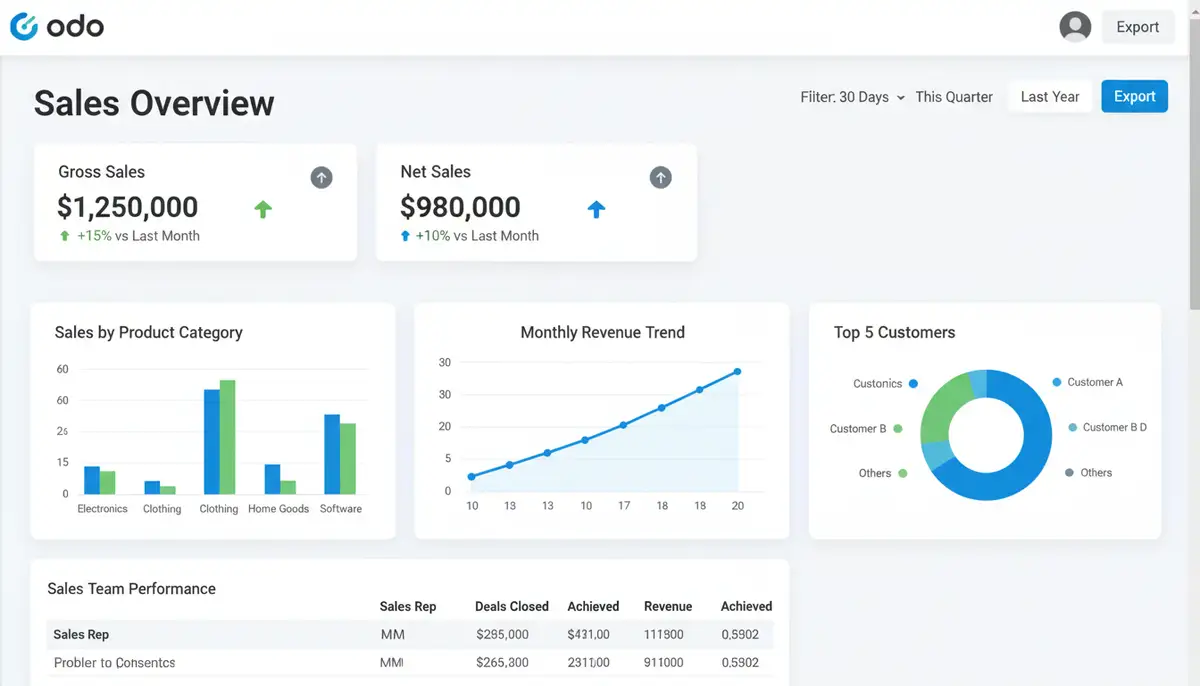
- Utilize Reporting Tools: Leverage Odoo’s powerful reporting and dashboard features to visualize gross sales vs net sales trends. Customize reports to gain specific insights into deduction categories.
- Train Your Team: Ensure your sales, accounting, and customer service teams understand the importance of accurate data entry and the impact of their actions on gross sales vs net sales.
Leveraging Odoo for Gross and Net Sales Tracking
Odoo provides a comprehensive suite of tools to manage your sales and financial data. This ensures you always have an accurate view of your gross sales vs net sales. Odoo 19, with its enhanced features, makes this even more intuitive.
Odoo Accounting Module Overview
The Odoo Accounting module is the central hub for all your financial transactions. It automatically integrates with other modules like Sales, Inventory, and CRM. This integration ensures that every sales order, invoice, payment, return, and discount is recorded accurately. It provides a single source of truth for your financial data. This eliminates data silos and reduces reconciliation efforts.
Odoo’s robust accounting features allow for real-time tracking of revenue. It manages accounts receivable and payable. It also generates powerful financial reports. This makes it easier to understand your gross sales vs net sales at any given moment. You can monitor your financial health with confidence.
Finding Gross Sales in Odoo 19 Accounting
In Odoo 19, finding your gross sales is straightforward. All sales invoices created in the Sales module automatically post to the Accounting module. Your gross sales represent the total value of these invoices before any credit notes or discounts are applied.
- Navigate to the ‘Accounting’ module.
- Go to ‘Reporting’ and then ‘Profit & Loss’ or ‘Executive Summary’.
- Look for your ‘Product Sales’ or ‘Income’ accounts. The total revenue listed here, before deducting returns or discounts, represents your gross sales for the selected period.
- Alternatively, you can go to ‘Invoicing’ > ‘Customer Invoices’ and filter by ‘Status: Posted’ and sum the total amount.
Finding Net Sales in Odoo 19 Accounting
Odoo automatically handles deductions for net sales. When you process a customer return, Odoo creates a credit note. When you apply a discount, it’s recorded on the invoice. These deductions are automatically accounted for in your financial statements.
- From the ‘Accounting’ module, access ‘Reporting’ > ‘Profit & Loss’.
- Odoo’s Profit & Loss statement will show your ‘Product Sales’ (Gross Sales) and then typically separate lines for ‘Sales Returns’ or ‘Sales Discounts’.
- The ‘Net Sales’ figure is often presented as a subtotal after these deductions, or you can manually calculate it: Gross Sales – (Credit Notes + Discounts).
- For a detailed breakdown, you can also analyze the ‘General Ledger’ report, filtering by relevant sales and deduction accounts.
How Other Odoo Modules Enhance Sales Tracking
The power of Odoo lies in its integrated nature. Beyond Accounting, several modules contribute to a complete and accurate picture of gross sales vs net sales.
- Sales Module: Manages sales orders, quotations, and invoicing. It directly feeds gross sales data into accounting. It also tracks the origin of sales and potential discounts.
- CRM Module: Tracks customer interactions and sales opportunities. It helps identify reasons for returns or allowances, linking back to customer satisfaction and sales quality.
- Inventory Module: Manages stock levels and product movements. It records returned items, impacting inventory valuation and reorder points.
- E-commerce Module: If you sell online, this module captures all web sales, applies discounts, and processes returns, all seamlessly integrated with Accounting.
This holistic approach ensures that every transaction is captured and reflected accurately in your gross sales vs net sales figures. It provides a single, unified view of your business operations. This is a significant advantage over disparate systems used by companies relying on fragmented solutions from providers like o2btechnologies.com or odooimplementers.com.

When to Involve an Odoo Consultant
While Odoo is user-friendly, setting it up for optimal financial reporting, especially concerning gross sales vs net sales, can be complex. This is particularly true for businesses with unique sales processes, complex discount structures, or high return rates. That’s where an experienced Odoo consultant becomes invaluable.
- Complex Accounting Needs: If your business has specific revenue recognition rules or intricate deduction categories, an Odoo consultant can configure the system to handle these precisely.
- Integration Challenges: Integrating Odoo with existing legacy systems or third-party applications requires expert knowledge to ensure data flows correctly and impacts gross sales vs net sales accurately.
- Custom Reporting: While Odoo offers robust standard reports, you might need custom dashboards or reports tailored to your specific KPIs. A consultant can build these for you.
- Process Optimization: An Odoo consultant can analyze your current sales and accounting workflows. They can recommend best practices and configure Odoo to streamline operations, improving data accuracy.
- Scalability Planning: As your business grows, ensuring your Odoo setup can scale with your needs is critical. A consultant helps future-proof your system, ensuring continued accurate tracking of gross sales vs net sales.
Odiware Technologies specializes in Odoo ERP implementation and custom software solutions. We help businesses streamline operations and enhance productivity. We ensure your system is configured to provide clear insights into gross sales vs net sales. Our expertise goes beyond basic setup. We focus on delivering solutions that drive real business value. We can help you avoid common pitfalls seen with less experienced providers like ksolves.com.
Don’t let complex financial reporting hinder your business growth. ‘Talk to our experts’ at Odiware Technologies today. We can help you leverage Odoo to its full potential.
FAQs About Gross Sales vs Net Sales
Q1: Is Gross Sales always higher than Net Sales?
Yes, gross sales are almost always higher than net sales. Net sales are calculated by subtracting deductions (returns, allowances, discounts) from gross sales. Therefore, net sales will always be equal to or less than gross sales. If they are equal, it means there were no deductions.
Q2: Which metric is more important for investors?
Investors typically consider net sales more important. While gross sales show market reach, net sales reflect the actual revenue a company generates after all adjustments. Net sales are a more accurate indicator of a company’s financial health and its ability to generate profit. They are used in key profitability ratios.
Q3: How do sales discounts affect gross sales vs net sales?
Sales discounts reduce net sales, but not gross sales. Gross sales remain the total value of the original transactions. The discount is subtracted from this gross amount to arrive at the net sales figure. This distinction is crucial for understanding the true revenue impact of your pricing strategies.
Q4: Can Odoo help reduce returns and allowances?
Yes, indirectly. Odoo’s integrated modules (CRM, Sales, Inventory) provide data to identify root causes of returns. For example, CRM can track customer complaints, Sales can analyze common return reasons, and Inventory can flag quality issues. By addressing these root causes, you can work to reduce future returns and allowances, thereby improving your net sales relative to gross sales.
Q5: How can I try Odoo Accounting for free?
Odoo offers a free trial for its modules, including Odoo Accounting. You can easily ‘Try Free Trial’ directly from the Odoo website. This allows you to explore its features and see how it can benefit your business’s financial tracking. It’s a great way to experience the power of Odoo firsthand.
Conclusion: Mastering Gross Sales vs Net Sales for Sustainable Growth
The distinction between gross sales vs net sales is fundamental to sound financial management. Gross sales show your raw revenue potential. Net sales reveal your true operational efficiency and profitability. Both metrics are essential. However, understanding their relationship is paramount for making informed strategic decisions. It ensures the long-term health of your business.
Leveraging a robust ERP system like Odoo is key to accurately tracking these figures. Odoo’s integrated modules provide the transparency and automation needed to manage your sales and financial data effectively. This empowers you to identify trends, address challenges, and capitalize on opportunities. It moves you beyond mere data collection to true business intelligence.
At Odiware Technologies, we believe in empowering businesses with the right tools and expertise. Our Odoo consulting services ensure your system is perfectly aligned with your business goals. We help you gain clear, actionable insights from your gross sales vs net sales data. Ready to optimize your financial reporting and drive sustainable growth? ‘Contact us’ today for a consultation. Let’s build a stronger financial future for your business together.


