In 2026, the global enterprise resource planning (ERP) market has shifted aggressively toward flexible, scalable solutions. According to Market.us data on ERP statistics, cloud-based deployments and AI integrations are driving unprecedented market growth, making it critical for businesses to adapt.

Maximizing Business Value: A Comprehensive Guide to Odoo Implementation Services in 2026
The SME Imperative: Why Odoo ERP Implementation is Non-Negotiable in 2026
The ERP Landscape in 2026: Why SMEs are Choosing Odoo
In 2026, the global enterprise resource planning (ERP) market has shifted aggressively toward flexible, scalable solutions. According to Market.us data on ERP statistics, cloud-based deployments and AI integrations are driving unprecedented market growth, making it critical for businesses to adapt. SMEs are increasingly choosing Odoo over legacy competitors because of its modular architecture. This allows companies to implement core applications like Accounting or CRM first, and subsequently add new modules as they grow, avoiding massive upfront licensing fees.
Overcoming the 'Feature Bloat' Trap in Modern Business Software
One of the most common pitfalls for growing businesses is "feature bloat," where organizations pay for complex software capabilities they never use. An effective Odoo ERP implementation strategically maps software functionality directly to real-world business needs. Instead of forcing employees to adapt to rigid software flows, a tailored Odoo setup ensures that the technology molds to your established processes. This lean approach not only reduces cognitive load for your workforce but also accelerates time-to-value for the software investment.
Understanding the 2026 Odoo Implementation Lifecycle
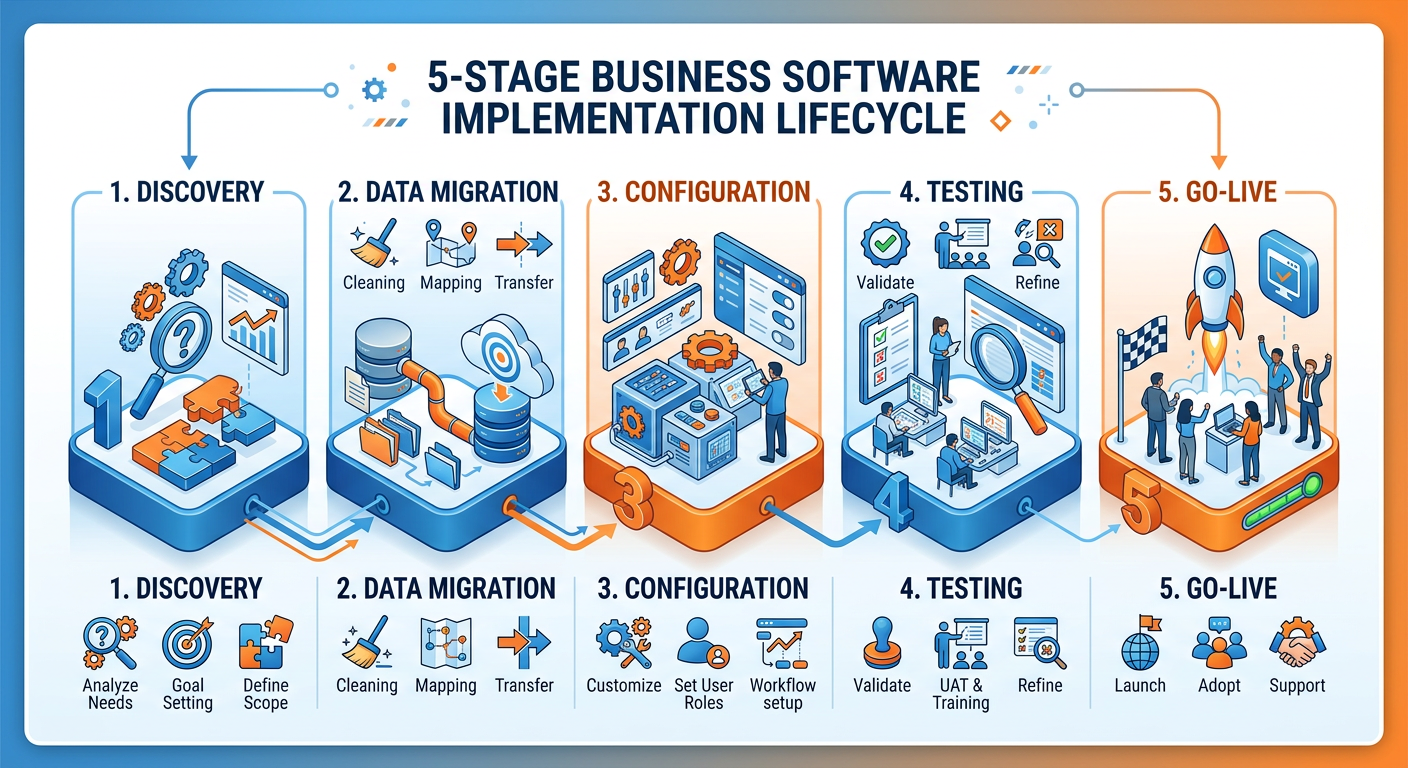
Phase 1: Discovery and Process Mapping — The Foundation of Success
The most critical stage of the deployment lifecycle happens long before any code is written. During the discovery phase, implementation partners conduct deep-dive workshops to audit your current operational workflows. This involves identifying bottlenecks, redundant tasks, and data silos that hinder productivity. A meticulously documented process map serves as the blueprint for the entire project, ensuring that the final configuration aligns perfectly with your business goals.
Phase 2: Data Migration and Technical Configuration — The Odiware Edge
Transferring historical data from legacy systems into a new ERP is notoriously complex. Odiware specializes in secure data migration, ensuring that vital customer records, financial histories, and inventory logs are scrubbed and seamlessly imported. Beyond basic data transfer, this phase involves configuring Odoo's core modules to reflect the operational workflows identified during discovery. Odiware's technical team bridges complex functional gaps, adapting the system to fit unique SME requirements.
Phase 3: Testing and User Adoption — Ensuring Cultural Alignment
Software is only as effective as the people using it. Comprehensive user acceptance testing (UAT) is crucial to validate that the configured system handles daily operations without friction. Following technical sign-off, the focus shifts to change management and employee training. Proper cultural alignment ensures that your team embraces the new tools rather than reverting to old spreadsheets, ultimately driving the success of the entire ERP initiative.
Future-Proofing with AI: Leveraging Odoo 18 and 19 Features
Odoo 18: Smart OCR and Predictive Analytics for Daily Operations
Released as the current standard, Odoo 18 has fundamentally transformed how SMEs handle administrative workloads. The platform features advanced, AI-driven optical character recognition (OCR) that automates invoice processing and receipt digitization with remarkable accuracy. Furthermore, predictive lead scoring within the CRM module and intelligent inventory forecasting enable businesses to make data-backed decisions faster. These built-in smart tools eliminate hours of manual data entry for finance and sales teams.
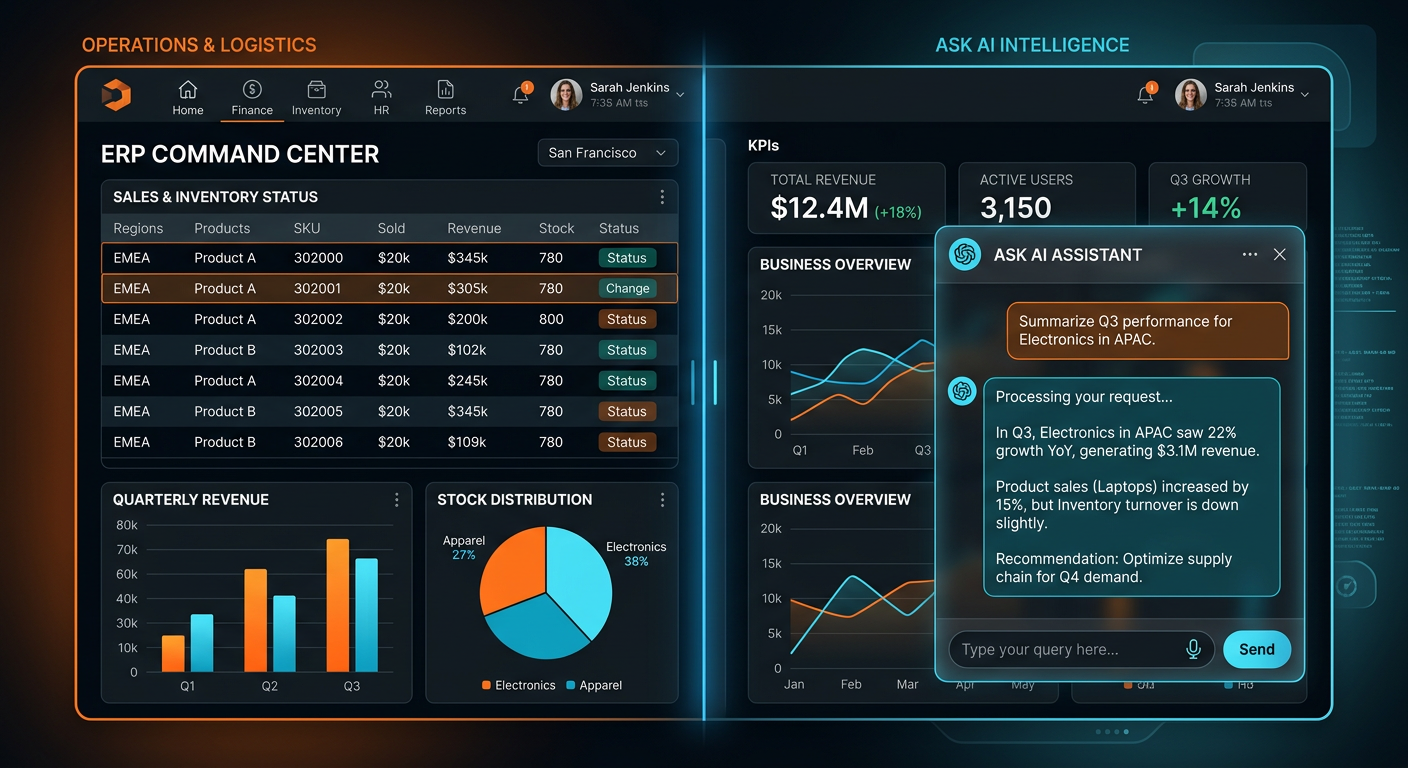
Odoo 19 & Beyond: Using 'Ask AI' for Conversational Business Intelligence
Looking toward the future, the Odoo 19 roadmap indicates a massive leap into Agentic AI and conversational reporting. Features like the 'Ask AI' conversational interface will allow users to query their database using plain English. For example, a manager could simply type, "Show me last quarter's most profitable products," and the system will instantly generate the relevant report. This democratizes data access, empowering non-technical staff to leverage complex business intelligence without relying on an IT department.
Implementation Rescue: Turning Failed Projects into Business Success
Why 60 Percent of ERP Projects Stall and How to Spot the Red Flags
Despite the obvious benefits of digital transformation, an alarming 60 to 68 percent of ERP projects fail to meet their original objectives. Common red flags include budget overruns, missed go-live deadlines, and severe user resistance due to a clunky configuration. Often, these failures stem from partnering with inexperienced vendors who lack a deep understanding of industry-specific processes or who botch the critical data migration phase.
The Rescue Process: Audit, Data Refactoring, and Stabilization
When an implementation goes off the rails, specialized rescue services are required to stabilize the environment. The recovery process begins with a comprehensive technical audit to identify broken code, misconfigured workflows, and corrupt data. From there, experts systematically refactor the system architecture and clean the databases. By addressing the root causes of system failure and providing targeted user retraining, a stalled project can be revitalized and realigned with its original business objectives.
Measuring ROI and Scalability: The Economic Impact of Odoo
The 12-Month Payback: Calculating Your ERP Return on Investment
Investing in a robust ERP platform offers measurable financial returns if deployed correctly. Industry benchmarks from Anchor Group indicate that the average ERP implementation yields a 52% ROI, effectively generating $1.52 for every dollar spent. For most SMEs utilizing expert Odoo implementation services, the payback period sits between 12 to 18 months. These savings are primarily driven by massive reductions in administrative labor, optimized inventory holding costs, and accelerated order-to-cash cycles.
Scaling Without Friction: How Odoo Grows with Your Revenue
True scalability means that your software can handle a doubling of your revenue without requiring a doubling of your administrative headcount. Odoo’s open-source, modular design ensures that as your business expands into new markets or launches new product lines, the system scales with you in real-time. Whether you are adding a sophisticated manufacturing module or integrating advanced e-commerce capabilities, the core architecture remains stable and fast.
Odiware’s Strategic Approach: Bridging Technical Gaps and Custom Development
Custom Module Development: Solving the HRMS and CRM Gaps
While Odoo provides an exceptional out-of-the-box experience, many SMEs have highly specific operational requirements that standard features cannot accommodate. Odiware bridges these technical gaps through advanced custom module development. Whether you need a highly specialized Human Resource Management System (HRMS) for complex payroll laws or custom CRM workflows tailored to a unique sales cycle, custom development ensures your software matches your exact needs.
Migration Excellence: Moving from Legacy Systems or Older Odoo Versions
Transitioning from disparate legacy systems—or upgrading between major Odoo versions—requires surgical precision. By referencing successful case studies, such as navigating the complex migration from Odoo v18 to v19, Odiware demonstrates a proven methodology for minimizing downtime. This migration excellence ensures that historical data integrity is maintained while instantly granting users access to the latest security patches and AI-driven features.
Ensuring Long-Term Success: Transparent Support SLAs and Post-Go-Live Care
The Importance of Support SLAs in ERP Continuity
Going live is just the beginning of your ERP journey. To maintain operational continuity, businesses require robust post-go-live care backed by clear Service Level Agreements (SLAs). An SLA guarantees response times for technical issues, ensuring that a system bug doesn't grind your supply chain or financial reporting to a halt. Without transparent, ongoing support, companies risk operational paralysis during critical business periods.
Odiware’s Commitment: Transparent Maintenance and Evolution Support
Odiware stands by its deployments with a commitment to transparent maintenance and proactive system evolution. This means not only fixing bugs when they arise but continuously optimizing the system as new features are released. By providing dedicated support channels and regular system health checks, Odiware ensures that your Odoo environment remains secure, fast, and fully aligned with your evolving business strategies in 2026 and beyond.
Conclusion: Your Path to Digital Transformation in 2026
Recap of Odoo's 2026 Value Proposition
In 2026, leveraging AI-enhanced software is mandatory for maintaining a competitive edge. From Odoo 18's smart OCR capabilities to the conversational intelligence slated for Odoo 19, the platform offers an unparalleled suite of tools for the modern SME. However, unlocking this potential requires more than just a software license; it demands an expertly managed deployment lifecycle that mitigates failure risks and ensures rapid user adoption.
Next Steps: Booking a Free Strategy Consultation
Don't let a poorly executed software rollout hinder your company's growth. Partnering with seasoned experts ensures that your transition to a unified ERP is seamless, scalable, and highly profitable. Take the first step toward true digital transformation by booking a free strategy consultation with Odiware today to discuss your unique business requirements.
Frequently Asked Questions (FAQ)
Get a free 30-minute review with an Odiware Odoo consultant — bring your current setup and we'll map the fastest route to a working configuration.
 ODOO IMPLEMENTATION PARTNER