In today’s fast-evolving business landscape, understanding what is B2B eCommerce is crucial for any enterprise looking to thrive. It represents a fundamental shift in how businesses interact and transact with each other. Gone are the days of manual orders and lengthy phone calls. Now, digital platforms streamline everything. This guide will explore the core aspects of B2B eCommerce, its benefits, and how to successfully integrate it into your operations by 2025.
What is B2B eCommerce: Defining the Digital Frontier
At its heart, B2B eCommerce, or business-to-business electronic commerce, is the online exchange of products, services, or information between two businesses. Unlike B2C (business-to-consumer) eCommerce, which targets individual shoppers, B2B focuses on the unique needs of companies. This includes bulk orders, negotiated pricing, and complex approval workflows. Businesses leverage digital channels to simplify procurement, sales, and supply chain management. For a broader understanding of this concept, you can explore this comprehensive overview of B2B e-commerce on Wikipedia.
The digital transformation has accelerated rapidly. Many businesses now expect the same seamless online experience in their professional lives as they do in their personal lives. This expectation drives the demand for robust B2B eCommerce solutions. It’s not just about having an online catalog; it’s about creating an efficient digital ecosystem. Companies like Odiware Technologies specialize in building these ecosystems, often leveraging powerful ERP systems like Odoo.
Why B2B eCommerce Matters in 2025
The question is no longer if you need B2B eCommerce, but how quickly you can implement it. The market demands efficiency, transparency, and personalization. Without a strong B2B eCommerce presence, businesses risk falling behind competitors. This digital shift impacts everything from sales cycles to customer satisfaction.
Key Benefits of Implementing B2B eCommerce
- Increased Efficiency and Automation: Automate order processing, invoicing, and inventory updates, reducing manual errors and saving time.
- Expanded Market Reach: Access new customers globally, transcending geographical limitations.
- Improved Customer Experience: Offer 24/7 ordering, personalized pricing, and self-service options, enhancing satisfaction.
- Reduced Operational Costs: Minimize administrative overhead associated with traditional sales methods.
- Better Data Insights: Gain valuable data on customer behavior, sales trends, and product performance to inform strategic decisions.
- Streamlined Order Management: Centralize all orders, making tracking and fulfillment more manageable.
- Enhanced Scalability: Easily handle increased order volumes without proportional increases in staffing.
These benefits directly contribute to a stronger bottom line and a more agile business. Understanding what is B2B eCommerce means recognizing its potential to transform your entire operational framework.
B2B vs. B2C eCommerce: A Clear Distinction
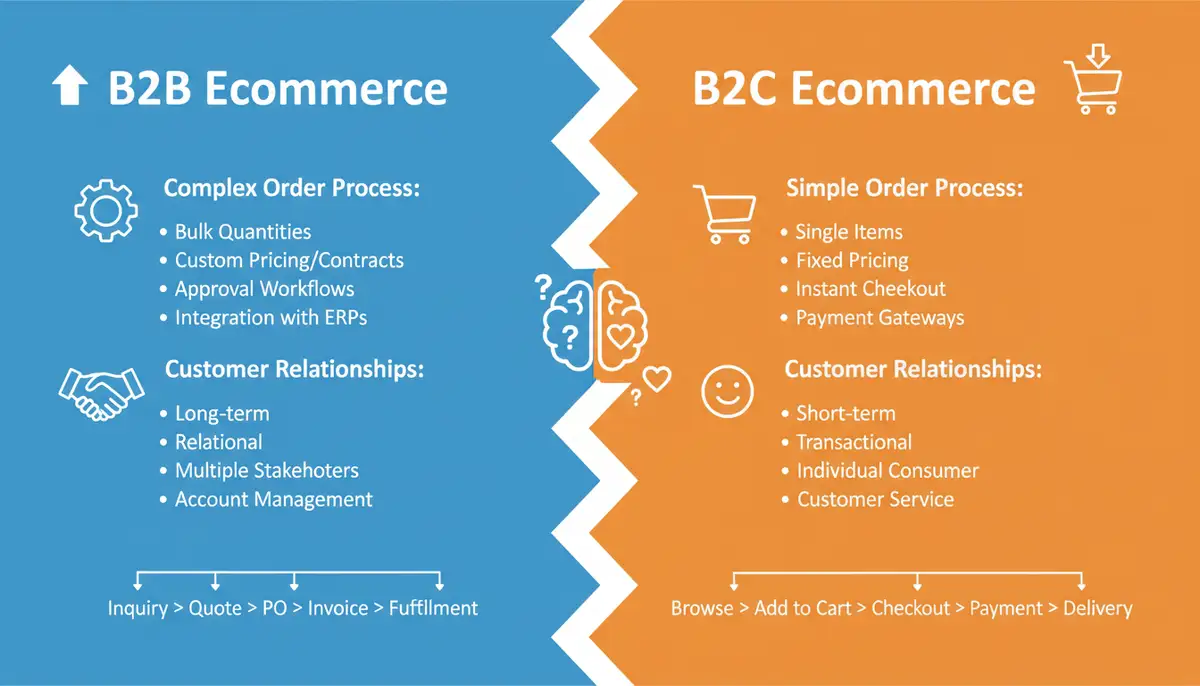
While both involve online transactions, the fundamental differences between B2B and B2C eCommerce are significant. B2C focuses on individual consumers, often driven by impulse and emotional buying. B2B, however, involves professional buyers making logical, long-term decisions. These decisions are often part of a larger procurement process. If you’re wondering what is B2B eCommerce, differentiating it from B2C is key.
| Feature | B2B eCommerce | B2C eCommerce |
|---|---|---|
| Customer Type | Businesses, organizations | Individual consumers |
| Buying Cycle | Longer, complex, multiple decision-makers | Shorter, often impulse-driven |
| Pricing | Negotiated, tiered, contract-based | Fixed, public |
| Order Volume | Large, recurring, bulk orders | Small, individual items |
| Payment Terms | Credit lines, purchase orders, invoicing | Credit card, digital wallets |
| Relationships | Long-term, strategic partnerships | Transactional, brand loyalty |
| Website Functionality | Account-based, custom catalogs, approval workflows | Guest checkout, wishlists, simple navigation |
This table highlights why a generic B2C platform won’t suffice for B2B needs. Businesses need specialized tools. They require features that support their unique purchasing processes and relationships. This is precisely where understanding what is B2B eCommerce becomes critical for platform selection. You can gain further insights into the business-to-business transaction model by reviewing this detailed explanation of B2B on Investopedia.
Essential Features of a Robust B2B eCommerce Platform
A successful B2B eCommerce platform goes beyond just listing products. It must act as a comprehensive digital hub. This hub connects buyers and sellers efficiently. Here are the core functionalities you should look for in 2025:
Account-Based Management

- Customer-Specific Catalogs: Display only relevant products and pricing to each logged-in business customer.
- Personalized Pricing: Support tiered pricing, volume discounts, and contract-specific rates.
- Credit Limits and Payment Terms: Integrate with accounting systems to manage credit lines and offer flexible payment options.
- Multi-User Accounts with Roles and Permissions: Allow different employees from a buying organization to access the account with specific roles (e.g., buyer, approver, finance).
Streamlined Ordering and Reordering
- Quick Order Functionality: Enable rapid ordering by SKU, CSV upload, or past purchase history.
- Bulk Ordering: Facilitate large quantity purchases with ease.
- Reorder Functionality: Allow customers to quickly reorder previous purchases, saving time.
- Purchase Order (PO) Support: Accept and process traditional purchase orders.
Integration Capabilities
- ERP Integration: Seamlessly connect with Enterprise Resource Planning systems (like Odoo) for real-time inventory, pricing, and customer data synchronization.
- CRM Integration: Link with Customer Relationship Management systems to provide a unified view of customer interactions.
- Payment Gateway Integration: Securely process various payment methods, including credit cards, ACH, and wire transfers.
- Shipping and Logistics Integration: Connect with carriers for real-time rates and tracking.
Robust Self-Service Options
- Order History and Tracking: Customers can view past orders, invoices, and track current shipments.
- Returns Management: Provide an easy process for initiating and tracking returns.
- Knowledge Base/FAQs: Offer self-help resources to answer common questions.
These features ensure that your B2B eCommerce platform serves as a powerful sales and support tool. It moves beyond a simple storefront. Instead, it becomes a strategic asset. For more on building your digital presence, consider exploring what is an ecommerce storefront and how it serves as your digital business hub.
Odoo and B2B eCommerce: A Powerful Synergy
When considering what is B2B eCommerce and how to implement it effectively, Odoo stands out as a highly capable platform. Odoo is an all-in-one business management software. It offers a comprehensive suite of applications. These include CRM, accounting, inventory, manufacturing, and, crucially, a powerful eCommerce module. This integrated approach is a game-changer for B2B businesses.
Odoo’s native integration means your B2B eCommerce store doesn’t operate in a silo. Instead, it’s deeply connected to your entire business backend. Real-time inventory updates prevent overselling. Customer-specific pricing is automatically applied. Order fulfillment processes are triggered instantly. This level of integration is essential for modern B2B operations. It significantly reduces manual data entry and potential errors.
- Unified Data Management: All customer, product, and order data resides in one system, ensuring consistency.
- Automated Workflows: From order placement to invoicing and shipping, processes are largely automated.
- Customization and Flexibility: Odoo’s open-source nature allows for extensive customization to fit unique B2B requirements.
- Scalability: Easily grow your B2B eCommerce operations as your business expands.
- Cost-Effectiveness: A single platform for multiple business functions often proves more economical than disparate systems.
Odiware Technologies, as an experienced Odoo consulting partner, helps businesses harness these capabilities. We ensure your Odoo B2B eCommerce implementation aligns perfectly with your strategic goals. We understand the nuances of B2B transactions. We configure Odoo to support complex pricing, customer portals, and integration with existing systems. This makes your digital transformation smooth and effective. You can learn more about the broader benefits of Odoo for modern enterprises.
Common Challenges in B2B eCommerce Implementation
While the benefits are clear, implementing B2B eCommerce comes with its own set of challenges. Being aware of these helps you plan better and avoid pitfalls. Understanding what is B2B eCommerce also means understanding its complexities.
- Complex Pricing Structures: Managing tiered pricing, volume discounts, and custom contracts can be difficult without robust system capabilities.
- Integration with Legacy Systems: Connecting a new eCommerce platform with older ERP or accounting systems often presents technical hurdles.
- Change Management: Getting internal teams and existing customers to adopt a new digital platform requires careful planning and communication.
- Data Migration: Moving large volumes of customer, product, and order data accurately can be a daunting task.
- Security Concerns: Protecting sensitive business data and ensuring secure transactions is paramount.
- Personalization at Scale: Delivering a personalized experience to a diverse B2B customer base, each with unique needs, is challenging.
Addressing these challenges requires expertise and a strategic approach. This is where an experienced partner like Odiware Technologies becomes invaluable. We guide you through each step. We ensure your B2B eCommerce project is successful. This allows you to fully realize the potential of what is B2B eCommerce for your business.
Best Practices for a Successful B2B eCommerce Strategy
To maximize your return on investment, follow these best practices when developing your B2B eCommerce strategy. These insights are drawn from years of experience in the field.
- Start with a Clear Strategy: Define your goals, target audience, and unique value proposition before selecting a platform.
- Prioritize User Experience (UX): Design an intuitive, easy-to-navigate interface that mirrors B2C simplicity while offering B2B functionality. As Forbes suggests, B2B companies must simplify their shopping journey, channeling the B2C ordering experience, as detailed in this Forbes article on B2B eCommerce.
- Focus on Integration: Ensure seamless connectivity with your ERP, CRM, and other critical business systems from day one.
- Offer Self-Service Options: Empower your customers with tools to manage their accounts, orders, and inquiries independently.
- Personalize the Experience: Leverage data to offer tailored product recommendations, pricing, and content to different customer segments.
- Provide Excellent Support: Even with self-service, ensure robust customer support channels are available.
- Iterate and Optimize: B2B eCommerce is an ongoing journey. Continuously analyze data, gather feedback, and make improvements.
- Invest in SEO and Digital Marketing: Ensure your B2B eCommerce site is discoverable by your target audience through effective online marketing strategies.
By adhering to these principles, you build a foundation for long-term success. You move beyond merely understanding what is B2B eCommerce to actively leveraging its power. This approach ensures your digital storefront becomes a truly effective sales channel. Here is a short video that provides a good overview of what is B2B eCommerce:
When to Involve an Odoo Consultant for Your B2B eCommerce Project
While the idea of DIY might be tempting, complex B2B eCommerce implementations often benefit significantly from expert guidance. Knowing when to engage a consultant is a strategic decision. It can save you time, money, and headaches in the long run. Odiware Technologies specializes in this area. We help businesses navigate the intricacies of Odoo B2B eCommerce.
- Complex Business Processes: If your business has unique pricing rules, approval workflows, or intricate supply chain requirements.
- Integration Needs: When seamless integration with existing ERP, CRM, or other legacy systems is critical.
- Scalability Concerns: If you anticipate significant growth and need a platform that can evolve with your business.
- Lack of Internal Expertise: If your team lacks specialized knowledge in B2B eCommerce platforms or Odoo implementation.
- Desire for Customization: When off-the-shelf solutions don’t meet your specific needs and require tailored development.
- Risk Mitigation: To minimize potential errors, delays, and cost overruns associated with complex projects.
Working with a seasoned Odoo consultant, like our team at Odiware, ensures your project is executed efficiently. We bring industry best practices and deep technical knowledge to the table. We help you define what is B2B eCommerce for your specific context. We also provide solutions that are robust, scalable, and aligned with your business objectives. This partnership approach ensures you get the most out of your investment.
Future Trends in B2B eCommerce
The B2B eCommerce landscape is constantly evolving. Staying ahead of the curve is vital. Here are some trends shaping the future of what is B2B eCommerce:
- AI and Machine Learning: Personalizing experiences, predicting demand, and automating customer service through chatbots.
- Voice Commerce: Enabling hands-free ordering, especially useful in industrial or warehouse settings.
- Augmented Reality (AR) and Virtual Reality (VR): Allowing businesses to visualize products in their own environment before purchase.
- Headless Commerce: Separating the front-end presentation from the back-end logic for greater flexibility and faster innovation.
- Subscription Models: Offering recurring purchases and service agreements through automated subscription management.
- Mobile-First Experiences: Optimizing B2B platforms for mobile devices, recognizing that buyers are increasingly on the go.
- Sustainability and Ethical Sourcing Transparency: Providing clear information about product origins and environmental impact.
These trends highlight the ongoing innovation in the B2B space. Businesses that embrace these advancements will gain a significant competitive edge. Partnering with an expert like Odiware Technologies can help you integrate these forward-thinking solutions. We help you prepare for the future of what is B2B eCommerce.
Navigating the Competitive Landscape: Odoo vs. Other Solutions
The market for B2B eCommerce solutions is diverse. Many platforms offer various features and capabilities. While Odoo provides a comprehensive, integrated approach, businesses might also consider other solutions from providers like serpentcs.com, o2btechnologies.com, or cybrosys.com. Each has its strengths, often catering to specific niches or business sizes.
The key is to evaluate your unique business needs against the offerings of different platforms. Odoo’s strength lies in its unified ecosystem. It brings together ERP, CRM, and eCommerce into a single, cohesive system. This integration often reduces complexity and improves data flow significantly. Other solutions might excel in specific areas, such as highly specialized product configurations or industry-specific compliance.

When comparing, consider factors like total cost of ownership, scalability, customization options, and the ease of integration with your existing systems. An Odoo consultant can provide an unbiased assessment. We help you understand how Odoo stands against other market players. We ensure you select the best fit for your long-term strategy. This ensures your understanding of what is B2B eCommerce translates into a practical, effective solution.
FAQs About B2B eCommerce
What is B2B eCommerce and how is it different from B2C?
B2B eCommerce involves online transactions between businesses. B2C eCommerce involves transactions between a business and an individual consumer. Key differences include pricing models, order volumes, payment terms, and customer relationships. B2B typically features complex, negotiated pricing and larger, recurring orders.
What are the biggest benefits of B2B eCommerce?
The biggest benefits include increased operational efficiency, expanded market reach, improved customer experience through self-service, reduced operational costs, and better data insights for strategic decision-making. It transforms how businesses buy and sell.
Can Odoo handle complex B2B pricing and workflows?
Yes, Odoo is highly capable of handling complex B2B requirements. Its integrated nature allows for customer-specific pricing, tiered discounts, credit limits, and custom approval workflows. These features are all seamlessly connected to inventory and accounting. This makes it a strong contender for what is B2B eCommerce for many businesses.
How long does it take to implement a B2B eCommerce platform?
Implementation timelines vary greatly depending on complexity, customization needs, and integration requirements. A basic setup might take a few weeks. A comprehensive, fully integrated solution with custom features could take several months. Proper planning and an experienced partner can significantly streamline the process.
What should I look for in a B2B eCommerce consulting partner?
Look for a partner with proven experience in B2B implementations, deep knowledge of your chosen platform (like Odoo), strong integration capabilities, and a consultative approach. They should understand your business goals and provide tailored solutions, not just generic software deployment. Odiware Technologies fits this profile, offering specialized Odoo ERP consulting services.
Conclusion: Embracing the Future of B2B Transactions
Understanding what is B2B eCommerce is no longer an academic exercise. It is a strategic imperative for businesses in 2025. The digital landscape demands efficiency, personalization, and seamless integration. A robust B2B eCommerce platform empowers your business to meet these demands. It drives growth and strengthens customer relationships. It transforms your sales operations.
The journey to digital transformation can be complex. However, with the right strategy and a knowledgeable partner, it becomes a clear path to success. Odiware Technologies stands ready to guide you. We specialize in Odoo ERP implementation and custom software solutions. We help businesses streamline operations and enhance productivity. We ensure your B2B eCommerce strategy is not just effective, but future-proof.
Don’t let the complexities of B2B eCommerce hold your business back. Embrace the power of digital transformation. Empower your customers and sales teams. If you’re ready to explore how a tailored Odoo B2B eCommerce solution can benefit your enterprise, we invite you to ‘Talk to our experts’. Let’s build a digital future for your business, together.