


Navigating the Future: Cloud ERP vs On-Premise ERP
In today’s fast-evolving business world, choosing the right Enterprise Resource Planning (ERP) system is crucial. It’s a decision that impacts every part of your operations. One of the biggest dilemmas businesses face is the fundamental choice between cloud ERP vs on-premise ERP. This isn’t just a technical decision; it’s a strategic one that shapes your company’s agility, cost structure, and future growth potential. As an Odoo consultant at Odiware, I often guide clients through this critical evaluation. Understanding the core differences between cloud ERP vs on-premise ERP is your first step towards a successful digital transformation.
The landscape of business software has changed dramatically. What once was a clear-cut choice now involves many nuances. We will explore both options in detail. We will help you understand which deployment model aligns best with your unique business needs in 2025 and beyond.
What Exactly is Cloud ERP?
Cloud ERP refers to an ERP system hosted on a vendor’s servers and delivered over the internet. You access the software through a web browser. This model is often called Software-as-a-Service (SaaS). The vendor manages all the IT infrastructure, including hardware, software updates, and security. You pay a subscription fee, typically monthly or annually. This makes it a popular choice for businesses seeking flexibility and lower upfront costs. Cloud ERP solutions offer many advantages. They reduce the burden on your internal IT team. This allows them to focus on strategic initiatives instead.
Odoo, for instance, offers a robust cloud-based solution. This allows businesses to get started quickly. They benefit from continuous updates and minimal maintenance worries. This model provides significant scalability. You can easily add or remove users and modules as your business grows or changes. This flexibility is a major draw for many modern enterprises. It allows them to adapt quickly to market demands.
The Advantages of Cloud ERP
- Lower Upfront Costs: No need to purchase expensive servers or infrastructure. You pay a predictable subscription fee.
- Faster Deployment: Cloud ERP systems can be implemented much quicker. This means you see value sooner.
- Scalability and Flexibility: Easily scale resources up or down based on business needs. Add users or modules with ease.
- Automatic Updates and Maintenance: The vendor handles all software updates, patches, and security. This reduces your IT workload.
- Accessibility: Access your ERP system from anywhere, on any device, with an internet connection. This supports remote work.
- Enhanced Security (Vendor Managed): Reputable cloud providers invest heavily in security infrastructure and expertise. This often surpasses what individual businesses can afford.
Understanding On-Premise ERP
On-premise ERP means the software is installed and runs on servers located within your company’s physical premises. Your business owns and maintains all the hardware and software licenses. This includes managing updates, backups, and security. It offers a high degree of control over your data and system customization. However, it also requires a significant upfront investment in infrastructure and IT staff. Many established businesses, especially those with stringent regulatory requirements or unique customization needs, have traditionally favored this model. For more insights on this, you can refer to this comprehensive overview of on-premise ERP. It highlights the responsibilities involved.
The decision for on-premise often comes down to control. You have full command over your data environment. This can be critical for certain industries. This model also allows for deep customization. You can tailor the system to very specific, niche processes. However, this level of control comes with significant responsibility. Your internal IT team must manage every aspect of the system. This includes hardware, software, and security protocols.
The Benefits of On-Premise ERP
- Full Control: You own and manage the entire infrastructure and data. This provides complete autonomy.
- Extensive Customization: Greater ability to tailor the software to highly specific, unique business processes. No vendor limitations.
- Data Security and Compliance: For some industries, keeping data on-site is a regulatory requirement. You have direct control over security measures.
- No Recurring Subscription Fees: After the initial purchase, you own the software license. This can lead to lower long-term costs if infrastructure is already in place.
- Performance: Potentially faster performance for users within the local network. This reduces latency.
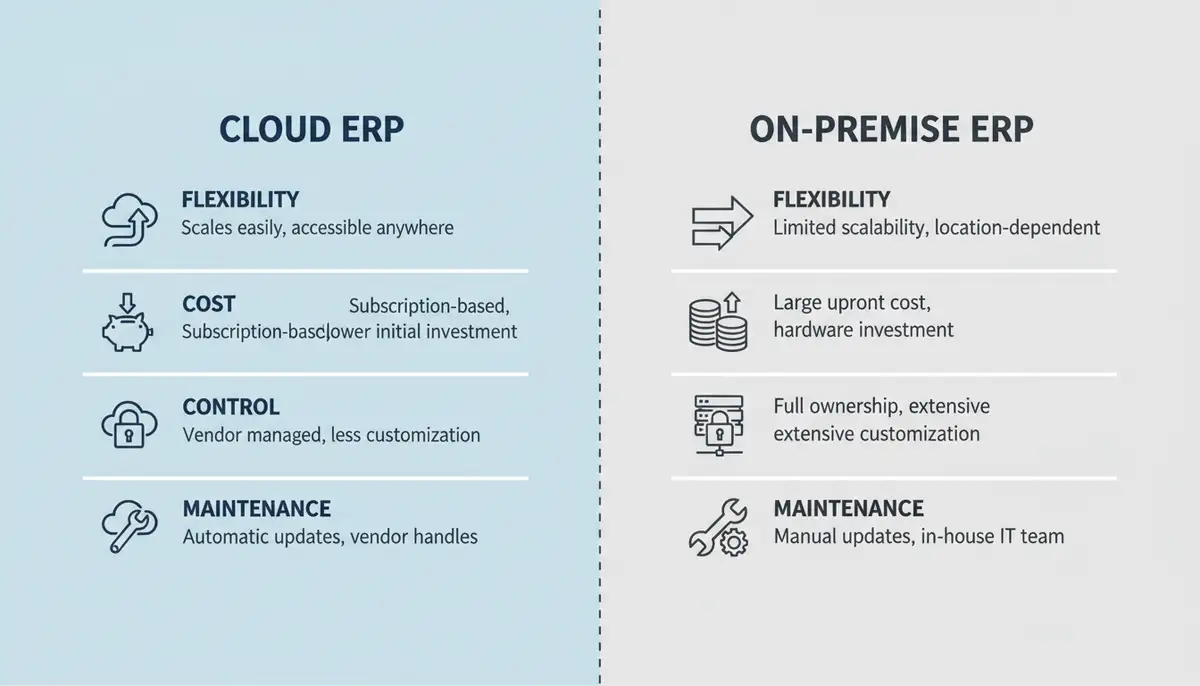
Cloud ERP vs On-Premise ERP: A Direct Comparison
The core of the cloud ERP vs on-premise ERP debate lies in several key areas. These include cost, control, security, scalability, and maintenance. Each factor holds different weight depending on your business’s size, industry, and strategic goals. Let’s break down these differences to provide a clearer picture. Understanding these distinctions is vital for making an informed choice. It helps you align your ERP strategy with your overall business objectives.
| Feature | Cloud ERP | On-Premise ERP |
|---|---|---|
| Deployment | Vendor-hosted, accessed via internet | Self-hosted, on company servers |
| Upfront Cost | Low (subscription model) | High (hardware, software licenses) |
| Ongoing Cost | Predictable subscription fees | Maintenance, IT staff, upgrades, utilities |
| Control | Less (vendor manages infrastructure) | High (full ownership and management) |
| Scalability | Highly scalable (easy to add/remove resources) | Limited by existing infrastructure, requires manual upgrades |
| Maintenance/Updates | Managed by vendor (automatic) | Managed by internal IT team (manual) |
| Accessibility | Anywhere, anytime with internet | Primarily within company network (VPN for remote access) |
| Security | Vendor’s responsibility, robust infrastructure | Company’s responsibility, requires dedicated IT resources |
| Implementation Time | Faster (weeks to months) | Slower (months to a year or more) |
This table clearly illustrates the trade-offs. Cloud ERP offers agility and reduced IT overhead. On-premise ERP provides maximum control and customization. Your decision depends on what factors are most critical for your organization. For a deeper dive into these comparisons, you can read more about making the right choice for your business with cloud vs on-premise solutions. It provides valuable context.
Security: A Key Consideration in Cloud ERP vs On-Premise ERP
Security is often a major concern when discussing cloud ERP vs on-premise ERP. Many businesses worry about data security in the cloud. However, reputable cloud providers invest heavily in advanced security measures. These include encryption, intrusion detection, and regular audits. Their security often exceeds what most individual companies can achieve on their own. On-premise security relies entirely on your internal team’s expertise and resources. This means your data is as secure as your weakest link. It requires constant vigilance and investment. Therefore, it’s not simply a matter of ‘one is more secure than the other’ but rather ‘who is responsible for security and how well do they do it?’
The Odoo Perspective: Flexibility in Deployment
Odoo stands out because it offers flexibility in deployment. While Odoo’s cloud offering (Odoo Online or Odoo.sh) is popular for its ease of use and scalability, you can also host Odoo on-premise. This is often referred to as ‘self-hosting.’ This option gives businesses the control associated with on-premise solutions. It still leverages Odoo’s powerful features. Odiware specializes in both cloud and on-premise Odoo implementations. We can help you configure Odoo to meet your exact requirements, regardless of your chosen deployment model. This adaptability is one of the key benefits of Odoo for modern enterprises.
For businesses considering Odoo, the choice between cloud and self-hosted depends on various factors. These include existing IT infrastructure, budget, regulatory compliance, and desired level of customization. For example, a manufacturing company with specific data sovereignty laws might lean towards an on-premise Odoo deployment. This ensures all data remains within their control. Conversely, a rapidly growing e-commerce business might prefer Odoo Online for its quick deployment and scalability. It truly comes down to understanding your specific operational needs.
Common Misconceptions About Cloud ERP vs On-Premise ERP
There are several myths surrounding the cloud ERP vs on-premise ERP discussion. Let’s debunk a few common ones. First, many believe cloud ERP is always cheaper. While upfront costs are lower, subscription fees add up over time. On-premise systems have high initial costs but potentially lower long-term operational costs if managed efficiently. Second, some think on-premise is inherently more secure. As discussed, a dedicated cloud provider often has superior security. Third, the idea that cloud ERP lacks customization is outdated. Modern cloud platforms, like Odoo, offer extensive configuration options and integration capabilities. The main difference between on-premise ERP and cloud-based ERP often boils down to who manages the IT infrastructure and how much direct control you need over the physical servers, as explained in this detailed comparison of deployment and management. It’s about finding the right balance for your business.
- Myth 1: Cloud ERP means less control. Reality: You control the software’s configuration and data, but the vendor manages the infrastructure. This frees up your IT resources.
- Myth 2: On-premise is always more secure. Reality: Your security is only as strong as your internal IT capabilities. Cloud providers often have advanced, dedicated security teams.
- Myth 3: Cloud ERP is not customizable. Reality: Modern cloud platforms offer extensive configuration, API integrations, and even platform-as-a-service (PaaS) options for deeper customization.
- Myth 4: On-premise has no ongoing costs. Reality: You still incur costs for hardware maintenance, software licenses, upgrades, power, cooling, and skilled IT staff.
When to Choose Cloud ERP
Cloud ERP is an excellent choice for businesses prioritizing agility, rapid deployment, and predictable operating expenses. If your company has limited IT resources or wants to minimize capital expenditure, cloud is often ideal. Startups and small to medium-sized businesses (SMBs) frequently benefit from the scalability and accessibility of cloud solutions. Companies with a distributed workforce or those embracing remote work also find cloud ERP invaluable. It ensures everyone has access to critical business data from any location. This fosters collaboration and efficiency across teams. The ease of updates means you always use the latest features. This keeps your business competitive.
For example, a growing service company might choose cloud Odoo. They can quickly onboard new employees and integrate with other cloud-based tools. A manufacturing company looking for a best ERP for manufacturing might also consider cloud if they want to reduce their IT footprint and focus on production innovation. The key is to assess your strategic priorities. Cloud ERP aligns well with strategies focused on growth, flexibility, and operational efficiency.
When to Opt for On-Premise ERP
On-premise ERP is suitable for organizations that require absolute control over their data and infrastructure. This includes businesses in highly regulated industries. For example, government contractors or financial institutions often have strict compliance requirements. They might need to keep data on-site. Companies with unique, complex processes requiring deep, custom code modifications might also prefer on-premise. They can tailor the software without vendor limitations. If your company already has a robust IT department and significant server infrastructure, leveraging these existing assets can make on-premise more cost-effective in the long run. It is also an option if internet connectivity is unreliable or inconsistent in your primary operational locations.
Consider a large enterprise with a legacy system that needs extensive integration with proprietary hardware. An on-premise Odoo deployment would offer the necessary control. It allows for complex integrations and data migration strategies. This choice is about balancing autonomy with the responsibility of managing a comprehensive IT environment. The decision between cloud ERP vs on-premise ERP is never one-size-fits-all. It requires careful consideration of your specific context.
Best Practices for Making Your Choice
Choosing between cloud ERP vs on-premise ERP requires a structured approach. Start by conducting a thorough needs assessment. What are your business goals? What are your current IT capabilities? What regulatory requirements must you meet? Engage key stakeholders from different departments. Their input is invaluable. Evaluate both short-term and long-term costs. This includes not just software licenses but also implementation, training, maintenance, and potential upgrades. Don’t forget to factor in the total cost of ownership (TCO). This provides a complete financial picture. Consider your future growth plans. Will the chosen system scale with you?
- Assess Your Business Needs: Define your specific requirements, pain points, and strategic objectives.
- Evaluate IT Resources: Determine your internal IT team’s capacity and expertise for managing an ERP system.
- Analyze Total Cost of Ownership (TCO): Look beyond initial costs to include ongoing maintenance, upgrades, and support.
- Consider Security and Compliance: Understand your industry’s regulations and data residency requirements.
- Plan for Scalability: Choose a solution that can grow and adapt with your business over time.
- Prioritize Customization Needs: Identify how much flexibility you need to tailor the system to unique processes.
Common Mistakes to Avoid
Many businesses make common errors when deciding on their ERP deployment. One major mistake is underestimating the TCO of on-premise solutions. They focus only on the initial license cost. They forget ongoing hardware, software, and personnel expenses. Another mistake is choosing cloud ERP without considering internet reliability. This can severely impact performance. Over-customization is also a pitfall, regardless of deployment. It can lead to complex systems that are difficult to upgrade or maintain. Failing to involve end-users in the decision-making process can result in low user adoption. This undermines the entire investment. Finally, not planning for data migration properly can cause significant disruptions. Watch this video for more insights on
to help you avoid common pitfalls.
When to Involve an Odoo Consultant (and Odiware’s Role)
The decision between cloud ERP vs on-premise ERP is complex. It involves technical, financial, and strategic considerations. This is where an experienced Odoo consultant becomes invaluable. At Odiware Technologies, we specialize in Odoo ERP implementation and custom software solutions. We help businesses streamline operations. Our team works as your partner. We assess your unique needs. We guide you through the pros and cons of each deployment model. We ensure your choice aligns perfectly with your business goals. We have extensive experience with various industries, including manufacturing, retail, and services. We understand the nuances that companies like odooimplementers.com, ksolves.com, and cybrosys.com also address in the market. Our focus is on delivering tailored Odoo solutions that drive real business impact.
Involving a consultant early can prevent costly mistakes. We help you define clear requirements. We assist with vendor selection, even for Odoo’s cloud offerings. We manage the implementation process. Our expertise ensures a smooth transition. Whether you opt for cloud Odoo or a self-hosted solution, Odiware provides end-to-end support. We ensure your ERP system is optimized for your success. Our goal is to empower your business. We want you to achieve enhanced productivity and sustained growth. Our deep understanding of the cloud ERP vs on-premise ERP landscape allows us to provide truly strategic advice.

Future Trends: Hybrid Models and Beyond
The future of ERP deployment isn’t strictly cloud ERP vs on-premise ERP. We are seeing a rise in hybrid models. These combine elements of both. A hybrid approach allows businesses to keep sensitive data on-premise. They can leverage the cloud for less critical functions or for scalability. This offers the best of both worlds for some organizations. Artificial intelligence (AI) and machine learning (ML) will also play a larger role. They will enhance ERP capabilities regardless of deployment. These technologies will drive greater automation and predictive analytics. Staying informed about these trends is important. It helps you future-proof your ERP strategy. The core choice between cloud ERP vs on-premise ERP will continue to evolve, but the principles of aligning technology with business needs will remain constant.
Frequently Asked Questions (FAQs)
Q1: Is cloud ERP always cheaper than on-premise ERP?
Not necessarily. While cloud ERP has lower upfront costs due to its subscription model, on-premise ERP can be more cost-effective in the long run for some businesses. This is especially true if they already have robust IT infrastructure and staff. You must consider the Total Cost of Ownership (TCO) for both options. This includes all direct and indirect costs over several years.
Q2: Can I customize a cloud ERP system?
Yes, modern cloud ERP systems, including Odoo, offer significant customization capabilities. This often includes configuration options, integrations with other software via APIs, and even platform-as-a-service (PaaS) environments for deeper development. While direct access to the underlying server might be limited, the flexibility for tailoring the application itself is extensive.
Q3: What are the main security differences?
With cloud ERP, the vendor is responsible for infrastructure security. They often have advanced security protocols and dedicated teams. For on-premise ERP, your internal IT team is solely responsible for all security measures. The ‘better’ option depends on your organization’s security expertise and resources. Both models can be highly secure with proper management.
Q4: How long does implementation take for each?
Cloud ERP generally offers faster deployment, often taking weeks to a few months. On-premise ERP implementations typically take longer, ranging from several months to over a year. This is due to the need for hardware procurement, server setup, and extensive configuration within your own environment. The complexity of your business processes also plays a significant role.
Q5: What is a ‘hybrid’ ERP model?
A hybrid ERP model combines elements of both cloud and on-premise deployments. For instance, a business might host its core ERP modules on-premise for maximum control over sensitive data. They might then use cloud-based modules for less critical functions like CRM or HR, benefiting from scalability and accessibility. This approach offers a balance of control and flexibility.
Conclusion: Your Strategic ERP Partner
The decision between cloud ERP vs on-premise ERP is one of the most impactful choices your business will make. It’s not just about technology; it’s about your operational efficiency, financial health, and future growth. There’s no universal ‘best’ answer. The ideal solution depends entirely on your unique business context, resources, and strategic vision for 2025 and beyond. Understanding the nuances of cloud ERP vs on-premise ERP is crucial for making an informed decision.
At Odiware Technologies, we believe in empowering businesses with the right Odoo solutions. Our experienced consultants are here to help you navigate this complex landscape. We provide expert guidance tailored to your specific needs. We ensure you make a choice that truly supports your long-term success. Don’t leave this critical decision to chance. Let us help you unlock your business’s full potential. Ready to discuss your ERP strategy? Contact us today for a personalized consultation.


